04 October 2018

Now You See Her... or, Money, Murder and Madness, Part Three

Sue Hill
portrait sketch by Rebecca J. Becker
Now You See Her... or, Money, Murder and Madness,
Part Three
by Rebecca J. Becker


Sue Hill woke up one morning in July, 1921 to find headlines calling for the arrest of a cold-blooded killer - - a man who slashed his 8-year-old stepdaughter's throat, tied heavy weights to her body and threw her - - still alive - - into an irrigation ditch to drown.


The alleged killer was Sue's brother, William Riley Hill.


William Riley Hill
portrait sketch by Rebecca J. Becker


Sue knew her brother was innocent. When W.R.'s attorney, the infamous Moman Pruiett, asked Sue to come and play a very large role in her brother's trial, she readily agreed.


Moman Pruiett

At the jury selection on October 25th, Sue Hill was in the courtroom, causing quite a stir among journalists covering the grisly case: 

Denver Rocky Mountain News [Denver, Colorado], 26 October 1921, Page One: 

Seated at Hill’s side in the courtroom, which was jammed to capacity even thru the tiresome questioning that continued throughout the day, was Miss Sue Hill, young and beautiful sister of the accused man. She will be one of the bulwark witnesses for the defense.

She came from Oklahoma City with Attorneys Williams and Pruiett to be with her brother in his fight for his life. Her testimony will bear directly upon the character of Hill’s wife, mother of the murdered girl.

She amply demonstrated the vaunted steadfastness of Hill’s relatives in his hour of tribulation and their belief in his innocence by the fervent kiss she planted on his lips as she entered the courtroom.

Denver Rocky Mountain News 24 February 1922
Clockwise from top left: unidentified prisoner handcuffed
to William Riley Hill, William Riley Hill,
Thelma (W.R. Hill's wife, mother of Helen Maxine Short)
Helen Maxine Short, and Sue Hill

The Denver Post was even more rapturous: 

PRETTY SISTER BACKS BROTHER

Miss Sue Hill, sister of the man who is alleged to have tied steel tie plates about the neck of his stepdaughter and drowned her in an irrigation ditch because of his quarrel with the girl’s mother, returned to Brighton Wednesday from Denver. She is an extremely pretty girl, with black hair and black eyes and is standing firmly beside her brother in the present trial. (1)

What no newspaper revealed was the astonishing secret Sue Hill was keeping as she sat by her brother in the Brighton courtroom.


Robert Oren Peevy
portrait sketch by Rebecca J. Becker

22 days earlier, in front of witnesses on a busy street in Sue's hometown, Pauls Valley, Oklahoma, Sue's ex-husband (and father of her son) shot her lover, Frank N. Pruett, five times.   Pruett had, at one time, been Peevy's best friend.  Both were well-respected and successful Pauls Valley businessmen. 


Frank N. Pruett
portrait sketch by Rebecca J. Becker

Immediately after this cold-blooded slaughter, Robert Oren Peevy turned himself in to the authorities.  He refused to explain his actions, and - - until his murder trial - - never uttered a single word to justify what he'd done.

 Local newspapers were quick to eulogize the dead man, one of the wealthiest citizens of Pauls Valley: 

Frank Pruitt had the instinct of a true gentleman and had many friends. He was free with all he possessed and his sympathies were always with the weak and defenseless. He was a kind and loving husband, son and brother, a good citizen and a useful man. Now that his gentle spirit has been called from earth those who loved him here find consolation in the thought that life’s fitful dream has ended and that he rests in peace, to awaken where sorrow can not sadden the soul nor affliction chill the heart. (2)

Although the murder happened three months after William Riley Hill's arrest, Sue's ex-husband's murder trial was set to begin a month before her brother's.  

On January 5, 1922, Pauls Valley Democrat summed up the town's reaction to Peevy's trial: 

This case promises to be one of the most intense interest, according to attorneys for both plaintiff and defendant, both sides seeming to hold to complete secrecy concerning vital points of the motives and shooting. It is understood that the defendant has never made a statement as to the real cause of the killing….

As you can imagine, given the glowing testimonials published after Frank N. Pruett's murder, it was going to take a miracle to exonerate Sue Hill's ex-husband, R. O. Peevy.

The first day of Peevy's trial began as the jury listened to the prosecution witnesses.

Peevy himself appeared in court,  "holding the hand of his little son, a lad of about seven years of age, who was his constant companion throughout the grueling first day of the trial." (3)

 Peevy's three months' silence had served to whip up public interest to a fever pitch:
According to attorneys, the trend of public opinion in a murder case has never before been so hard to define as it seems to be in this case.  The greatest silence of opinion has been observed by the entire public, concerning the crime, its motives, and the probable penalty. (4)

And then - - in a breathtakingly surprising move - -  the defense called their first witness: Robert Oren Peevy's divorced wife, Sue Hill.


The Daily Ardmorite11 January 1922

In her testimony she laid bare many intimacies of her life here while she was married and living with Peevey [sic], and alleged that the murdered man had made advances to her while she was living with her husband.
According to her statements she and Preuitt [sic] had made many trips together and had been close companions for months.
Her entire testimony was heard with tense and strained ears by the crowded court room, and it will have major bearing upon the weight of evidence in the case, it is believed by those who have followed the developments. (5)

She related stories that, even today, women would hesitate to reveal. 

The next day, County Attorney Mac Q. Williams "in possibly the hardest and most brilliant manner ever displayed," cross-examined Sue Hill.  Her story remained unchanged. 

Defense witnesses were called.  One of especial note, given subsequent events, was Billy Frame of Ardmore, Oklahoma.

Frame testified that he'd been Pruett's go-between, delivering notes and money to what the newspapers called Pruett's "clandestine love," Sue Hill.

And now we learn the truth behind Sue Hill's life-threatening illness in September 1919, mentioned in Part Two:  Dr. Walter Hardy, also of Ardmore, "testified that he had refused to perform an illegal operation on Mrs. Peevy at the request of Pruett."

Another individual must have acquiesced to Pruett's demands, leaving Sue Hill near death and alone, until her stepmother arrived to look after the young woman.
More than 150 witnesses were called for the trial, and approximately that number were examined on the stand. Bitterness in the battle between the attorneys was evident as the trial grew into its last stages...

Attorneys for the defense... made pleas of temporary insanity and the "unwritten law" in possibly the most hotly contested legal battle ever staged in a local court.  Interest in the trial, throughout the entire week of legal procedure, examination of witnesses, and argument, was at the highest pitch. (6)

 What would the jury decide?  What would happen to Sue's ex-husband, to Sue's brother, to her son, and to Sue herself?

Find out more when we continue next time with Now You See Her... Money, Murder and Madness, Part Four!


Sue Hill
portrait sketch by Rebecca J. Becker


------------------------------

(1) Denver Post [Denver, Colorado] 26 October 1921, Page 18.
(2)  Pauls Valley Democrat [Pauls Valley, Oklahoma] 13 October, 1921, Page 4.
(3), (4) and (5)  Pauls Valley Democrat [Pauls Valley, Oklahoma], 12 January 1922, Page One.
(6) Pauls Valley Democrat [Pauls Valley, Oklahoma], 19 January 1922, Page One.


Many thanks to Elizabeth Cooksey for her keen eye and fine tooth comb!   

03 September 2018

Now You See Her... or, Money, Murder and Madness, Part Two


Sue Hill
portrait sketch by Rebecca J. Becker
Now You See Her...
Or, Money, Murder and Madness - - Part Two
by Rebecca J. Becker

One whimsical feature in Crescent College’s 1914 yearbook was a list revealing each student’s favorite expression.  Nola Beam’s was, “You just kill me!”  Sue Hill’s was, simply, “Golly!”


Nola Beam (after a tumultuous beginning, running away with Sue Hill) finished a successful school year and went on to live a peaceful and happy life.

Sue Hill's story was much darker.  Warning: this is not a story for the very young, or for the squeamish.  

When we left her at the end of Part One, Sue had missed Crescent College's 1914 Commencement exercises in May because she'd gotten married in April. 

Robert Oren Peevy
portrait sketch by Rebecca J. Becker

We don't know how or when Robert Oren Peevy met Sue Hill, but on 7 May, 1914 Sue's hometown paper, the Pauls Valley Democrat, announced:
PEEVY-HILL
The Democrat was negligent last week in not announcing the important wedding of Mr. R. O. Peevy and Miss Sue Hill, which took place at Gainesville, Texas.  Mr. Peevy is proprietor of the Economy Store and he is one of the rising young business men of this city. 

The bride is a daughter of the late John T. Hill and was born and reared in this city. 

The family is prominent in social and business affairs, and she has been educated at the best schools in the land, and her personal charms and gentle disposition have made her many friends.

Mr. and Mrs. Peevy at present are at the Lovell hotel.
 
Frank N. Pruett
(Robert Oren Peevy's best friend)
portrait sketch by Rebecca J. Becker

Robert Oren Peevy's best friend, Frank Pruett, might have been a member of the wedding party, along with Sue's brother, William Riley Hill.  If so, two murderers and one victim would have shared in the nuptial celebration.

ad for the Economy Store in Pauls Valley, Oklahoma
(managed by Robert Oren Peevy)
from Pauls Valley Democrat, 2 July 1914

We wonder if Sue knew about Robert Oren Peevy's first wife?

Ten years before Sue arrived at Crescent College, Robert Oren Peevy married 17-year-old Maude Rydens. (1) 

Two years later, the couple had a son, Robert Oren Peevy, Jr.  

The marriage was disastrous, and shortly after the baby's birth, Robert and Maude divorced.  
 
Southwestern Insane Asylum, Bexar County, Texas

 Maude became an inmate in the Southwestern Insane Asylum in Bexar, Texas, where she stayed until her death five decades later.  

The asylum had her identified as a widow, although Robert Oren Peevy was very much alive. (2) 

Four months after Sue's wedding announcement, the same paper published much sadder news:

Lucile Robinson Hill
portrait sketch by Rebecca J. Becker

DEATH OF MRS. HILL
Mrs. Lucile Hill, wife of W. R. Hill, aged 18 years, after an illness of several months, died last Saturday in the hospital at El Paso, Texas... The deceased leaves one child, about three years old and her husband.

Lucile had been both Sue's stepsister and her sister-in-law.  Lucile had married Sue's brother, William Riley Hill, when she was 15, and had lost two baby boys after the birth of their daughter.  She died of tuberculosis.

Lucile's mother (Sue's stepmother), Mrs. Mattie Hill, traveled to Texas for the funeral.

[Hill family relationships can be a bit confusing, and so we've created a sort of Dramatis Personnae for you, which you'll find at the end of this article.]

During all this time, Mrs Mattie Hill, Sue herself, and all of her brothers and sisters were engaged in a series of lawsuits, trying to break the terms of her father's will.

Some of the lawsuits revolved around the question of race.  When Sue and William Riley Hill's little brother had been killed in 1913, a legal battle erupted: what would happen to his share of their father's fortune?  

His full-blood siblings wanted his money to be divided only among them, by virtue of their mother's Chickasaw blood.

Sue and William Riley were two of these siblings.

The court ruled against them, and demanded that the money be divided among all the heirs equally.

At this point, however, none of the children had inherited a penny, nor would they for years to come.  Their father's wishes remained in effect, and none of them was entitled to a cent of his fortune until the youngest child, Ruth (only eight years old in 1914) reached her majority.

Sixteen months after her marriage, Sue gave birth to her son, Lucian Howe Peevy. 

For the next few years danger and distress lurked just beneath the surface of Sue's life.  A few clues:  first, a brief line in The Daily Ardmorite, 27 September 1919:
Mrs. Mattie Hill was called to Temple, Texas, Saturday by the serious illness of Mrs. Sue Peevy.
No details were given describing Sue's illness.  (They were revealed four years later in her husband's murder trial, however.)

The 1920 U.S. Federal Census revealed the next clue: Sue and her two-year-old son Lucian were living on their own.  She was 22 years old, divorced, listed as the head of house, and her employment was given as "Investments in Real Estate Industry."

The third clue isn't a hint so much as a bludgeon.

"HELEN MAXINE SHORT.
Eight-Year-Old Girl,
Whose Body was Found in a Pond
Near Eno, Adams County."
Denver Post, 25 July 1921

Banner headlines in the Denver Rocky Mountain News, 25 July 1921,  pronounce:
STEPFATHER OF SLAIN GIRL SOUGHT

CHILD, 10, BOUND AND PITCHED INTO WATER ALIVE, IDENTIFIED AS DAUGHTER OF DENVER WOMAN

Mother Tells of Threats and Believes Man Murdered Girl to Get Revenge When She Stopped Sending Money to Him; Arrest Is Near

The 10-year-old girl found murdered by drowning late Saturday, was Helen Maxine Short, daughter of Mrs. Thelma Hill, this city. 
This is the bare statement of last night's latest developments in probably the most brutal murder case Adams County police annals show...
[W]eights tied to the child's neck by wires, the clutching position of her hands, the marks made by the wires on her throat, showed, the authorities believe, that the little girl was throw into the water alive and left to die.
The man for whom they searched was Sue's brother, William Riley Hill.


The caption reads: "Upper left - Mrs. Thelma Hill, whose young daughter was murdered nine miles south of Brighton.  Upper right - Helen Maxine Short, whose body was found weighted with iron in an irrigation ditch.  Below - William Riley Hill, stepfather of slain girl, for whom police are searching, and another photograph of murder victim." - - Rocky Mountain News, 26 July 1921.

A few months ago we published an article about another Crescent College student, Frances Beebe.   Frances testified at a series of murder trials where Moman Pruiett, the most notorious lawyer in Oklahoma, was the defense attorney. 

(Moman Pruiett was no relation to Frank N. Pruett, Robert Oren Peevy's best friend, who will play a key role in the murder trial upcoming in Part Three.)


Moman Pruiett

Moman Pruiett played an even greater role in Sue Hill's life, and he entered the stage at exactly this point.

Pruiett had been friends with Sue and William Riley Hill's father.  It wasn't friendship that motivated his actions in this case, however:
In a deed filed on August 12, 1921:  'KNOW ALL MEN BY THESE PRESENTS:  That I, William Riley Hill, son of John T. Hill, deceased, of Pauls Valley... do hereby grant, bargain, sell and convey unto Moman Pruiett of Oklahoma City, Oklahoma, all of the following described real estate situated in Garvin County, Oklahoma, to-wit...'
 Here the document listed the details involving a transfer of 2,350 acres of land from William Riley Hill to Moman Pruiett, "all of the above land being... included in the Estate of John T. Hill, deceased...."

As his biographer noted, "Pruiett took deed to a neat fortune, for the defense of a case he knew he couldn't win." (3)

The Denver Post,  28 July 1921
William Riley Hill is pictured, in profile

  A few days after the screaming headlines appeared across the nation, William Riley Hill was caught and arrested.  

 
Denver Post, 27 July 1921
William Riley Hill (third from left) shortly after his arrest

He agreed to be interviewed by the Denver Post.  He declared that his wife had run off with a barber, and he'd come to Denver to track them down.

He maintained that he was not the girl's stepfather - - that he was, rather, her real father.  He said he and Thelma, the girl's mother, had been involved while [his first wife] Lucile had still been alive, and that they'd married after Lucile died.
We always represented that the girl was Mrs. [Thelma] Hill's daughter by a previous marriage to save her embarrassment.

I thought I had a right to my own child.... I got the child from the home and left a note to my wife to meet me.  She didn't show up, so on Thursday I started to walk with the girl.... (4)
Sue's brother maintained that when a dark-complected foreigner drove by in an automobile, he gave the girl into the stranger's care rather than make her keep walking.  William Riley Hill swore that the man (possibly an Italian) promised to take the child back to Denver.

Thelma Hill
portrait sketch by Rebecca J. Becker

In the same newspaper, Thelma swore the child was not William Riley Hill's.  She intimated that Hill had forced her into a life of prostitution, and that she had taken the child and run away when Hill threatened them both:
Time and again he forced me thru fear of my life and my baby's life to get money for him and he didn't care how I got it.
Despite her story, newspapers found it hard to champion Thelma's cause - - in part because of her appearance:
Mrs. Hill has nothing about her of the timid or shrinking or fearful type of woman.  On the contrary, she is close to nature in manner, method and thought. 

On her left arm is a large tattooed ornament.  She is the sort of woman who loves hard and hates hard, who serves well, and when cast off fights for what she intends to take with her. 

Her consuming desire now is to kill William Riley Hill.  'The man who dragged me in the dirt, made me a thing of the street, and then killed my baby because I wanted to shield and protect her.'
Moman Pruiett, William Riley Hill's defense attorney, knew that Sue Hill would impress a jury and invoke much more sympathy than Thelma Hill ever could.  He sent for the girl to come provide support and assistance in her brother's cause.

But details of Helen's death, as they were revealed, were so appalling Pruiett began to doubt that even Sue Hill's beauty would help William Riley's case.

Helen Maxine Short
portrait sketch by Rebecca J. Becker

Headlines began to emphasize William Riley Hill's race.  Hill's mother was from a prominent Chickasaw family, but W.R. was constantly described as "a half-breed Indian."  His own appearance (one paper described him as "a little ratty-faced man, only five feet four inches tall, with a small, receding chin, a long, pointed nose, close-set eyes, swarthy complexion and several days' growth of beard") was exaggerated to indicate his guilt.  

Hundreds of men threatened to storm the prison where William Riley Hill was being held.

SHERIFF ADOPTS RUSE TO PREVENT VIOLENCE ON ARRIVAL IN DENVER

CHILD WAS HORRIBLY SLASHED WITH A RAZOR BEFORE MURDER

I am certain [stated the sheriff] the people of Colorado do not want a repetition of the acts of mob violence such as have occurred in Oklahoma and elsewhere.  I want to assure the people that nothing will be overlooked in bringing about quick justice in conformity with correct legal procedure. (5)
Finally, Hill was arraigned.  He pleaded not guilty.  His trial was scheduled for October 1921.  


From Rocky Mountain News [Denver, Colorado] 24 February 1922.  Clockwise, from top left:  unnamed prisoner in profile, handcuffed to William Riley Hill (facing forward), Thelma Short Hill (William Riley Hill's second wife), Helen Maxine Short (William Riley Hill's stepdaughter, or daughter) and Sue Hill. 

When the trial began in Brighton, Colorado, Sue Hill was there, protesting her brother's innocence and giving interviews to newspapers and magazines avid for her story.

She scoffed at Thelma's story of being forced into prostitution.  Sue Hill explained that William Riley had no need of his wife's money: they were heirs to their father's fortune, comprised of "Oklahoma oil and farm lands valued at $4,450,000."

Journalists across the country were taken with the girl and described her glowingly as "the beautiful star witness" who came all the way from Pauls Valley, Oklahoma in defense of her brother. 

Yet even as Sue sat in the courtroom, she was hiding an enormous secret.  Brighton might have seemed a world away from Pauls Valley, but before William Riley's trial was over, Colorado newspapers discovered the truth. (6)

FIRED FIVE SHOTS INTO BODY OF RIVAL

TWO MORE SORDID TRAGEDIES LINKED TO HILL MURDER TRIAL

LEADING FIGURES IN STRANGER TRAGEDY CHAIN

Sister of Accused and His Attorney Involved in Killings
 
The Denver Post
27 October 1921

What happened to Sue, and what became of her brother, William Riley Hill?  What new horrors had transpired between his arrest and her appearance at his trial?

For the final dramatic chapter in this story of money, murder and madness, check our next issue when we conclude Sue Hill's saga, with Now You See Her... Part Three.


Who's Who in Part Two
Sue Hill Peevy
(Crescent College alumna)
Robert Oren Peevy
(her husband)
Frank Pruett
(Robert Oren Peevy's best friend, he'll play a key role in the murder trial in Part Three)
Mrs. Mattie Robinson Hill
(Sue's stepmother)
Lucile Robinson Hill, deceased
(Mattie's daughter, Sue's stepsister and sister-in-law, wife of Sue's brother William Riley Hill)
William Riley Hill
(Sue's brother, widower of Lucile Robinson Hill)
Ruth Hill
(Mattie's daughter, Sue's half-sister, eight years old in 1914)
Moman Pruiett
(legendary and infamous attorney, no relation of Frank Pruett)
Thelma Short Hill
(William Riley Hill's second wife, Sue's sister-in-law, mother of Helen Maxine Short)
Helen Maxine Short
(William Riley Hill's stepdaughter (or daughter) by his second wife (Thelma Short Hill), Sue's niece)


Many thanks to Elizabeth Cooksey for her superlative help during several drafts of this article, and to Keith Scales for his continuing encouragement and advice.  As Sue Hill would say, "Golly!"


(1)  Peevy is often seen as Peevey, and sometimes as Peavey.  Rydens is often spelled as Ridings.
(2) 
Why she was committed, or by whom, is still unknown, but she stayed confined in an asylum until her death on Valentine's Day, 1961.

(3)  Howard K. Berry, He Made It Safe To Murder: The Life of Moman Pruiett.  Oklahoma Heritage Association, Oklahoma City, OK, Pages 543-544.
(4)  The Denver Post [Denver, Colorado] 27 July 1921, Page 1.
(5)  The Denver Post [Denver, Colorado] 29 July 1921, Page 11.
(6) 
The Denver Post [Denver, Colorado] 11 October 1921, Pages 1 and 4.


14 August 2018

Now You See Her... or, Murder, Money and Madness - - Part One

Nola Beam
portrait sketch by Rebecca J. Becker

 Now You See Her... or, Murder, Money and Madness, Part One

by Rebecca J. Becker


In all the history of Crescent College, only two girls ran away.  And they ran away together.


One of those girls lived happily ever after.  The other?  When she was 23, the other girl was a prime witness in two murder trials.  In two separate states.

For that girl, it might have been better if she'd just kept running.

This is the story of Nola Beam and Sue Hill, two Crescent College students who met when they began school together in September, 1913.  

Crescent College, Eureka Springs

The two girls had a lot in common, and very little of it was good.  

Be warned:  you're about to meet one murderer.  Another waits in the wings, where you'll meet him in Part Two.
 
Mourning Card

Nola was only six years old her when mother, Jennie Maxwell Beam, died.
 
West Main Street, Beebe Arkansas

Nola Beam's father was a very prominent man, rarely out of the Arkansas news. Harden Napoleon Beam helped found Beebe, Arkansas, and he worked tirelessly to promote the town's commercial advantages.  

Beebe, Arkansas
(photo courtesy of the White County Historical Society)

When he wasn't serving as mayor, he traveled around the country, touting the benefits of moving to Beebe.

Populist Party poster for William Jennings Bryan

 Surprisingly, H. N. Beam's political background had been as a prominent Populist Party member, a party famous for its rabidly anti-railroad monopoly and anti-bank platform.

"The Protectors of Our Industries" - 1883 Puck cartoon by Bernhard Gillam:
Jay Gould and his fellow robber barons are kept afloat
on the backs of the suffering laborers

Beam must have had a radical change of heart: he now worked for Iron Mountain Railway (owned by the notorious robber baron and king of monopolies, Jay Gould), and he was on the Board of Directors of the Bank of Beebe!

When Nola was ten, her father married 25-year-old schoolteacher, Nellie Mills.  
The Flower Girl
by Cecily Elmslie Shand

Only months later, Nola served as flower girl in another wedding: her eighteen-year-old sister, Laura, married another Iron Mountain Railroad employee. 
The radiantly beautiful bride is the fourth daughter of ex-Mayor H. N. Beam, a most charming blonde and a typical Southern beauty, talented and amiable, numbering her friends by the score, who will miss her very greatly....
                       - Arkansas Democrat [Little Rock, Arkansas] 2 May 1907, Saturday, Page 5.

Another sister, Ruth, served as her sister Laura's bridesmaid.  With Laura's marriage, Ruth and Nola were the only children left in their father's house.

But within the year, the Arkansas Democrat carried the news: 
Miss Ruth Beam, daughter of ex-Mayor H. N. Beam, is seriously ill at her father's residence on Front street.
- Arkansas Democrat [Little Rock, Arkansas] 21 January 1908, Page 5


That same day, Ruth died.

Less than two months later, newspapers carried a heartbreaking sequel: 
Mrs. Laura [Beam] Ginocchio... died at 2:30 o’clock yesterday morning, at the home of her father, H. N. Beam....  Her infant son, William Parker Napoleon Ginocchio, died at 2:35 o’clock yesterday afternoon, after living a trifle over 13 hours.
- Daily Arkansas Gazette [Little Rock, Arkansas] 14 March 1908, Saturday, Page 7


No one knows how Nola felt, or how her sisters' deaths affected her.  

Almost exactly a year after Laura's death, another baby was born: Lettie Beam was the first child born to Nola's father and stepmother.   


Nola, who'd been the youngest of seven children, finally got to be a big sister.

Any joy over Lettie was soon tempered by the first in a series of paralytic strokes H. N. Beam suffered.  

In the beginning he recovered quite well and was soon back in the newspapers, proposing ordinances against fireworks in Beebe, and shipping carloads of potatoes from his farm outside town.


A baby brother joined the family when Hugh Napoleon Beam was born in May, 1910, but Nola's father soon suffered another debilitating stroke.

Between the demands of two babies and the exigencies of the sickroom, the young Nell Beam may simply have had no time or attention to spare for her 14-year-old stepdaughter. 

Her father was too ill to look after Nola, and the girl was sent to Henderson College in Arkadelphia, Arkansas four months after her brother was born.


Nola Beam, first year preparatory student at Henderson College in Arkadelphia
(Nola is second from the right, front row)

As a boarding preparatory student, Nola was active in several extracurricular activities, including piano studies, and the school's literary society.

But two months before the end of the school year, Nola received word that her baby sister, Lettie, had died.     
                             
Little Lettie
Precious Daughter of H. N. & Nellie Beam
Born March 22, 1909
Died March 11, 1911
Aged 1 yr. 11 mo. 14 da.
"From mother's arms to the arms of Jesus."

 That summer must have been unspeakably sad, but worse was to come. 


Beebe, Sept. 7 - - H. N. Beam died at his home today at noon. His family were at his bedside when the end came, except his daughter, Mrs. E. H. Abington of Oklahoma City. He was stricken nearly two years ago with a slight attack of paralysis. Since that time he has been in gradual failing health. Three weeks ago it became apparent to his family and friends that his life’s work would soon close. He leaves surviving him his wife, one son and four daughters.
- Daily Arkansas Gazette [Little Rock, Arkansas] 08 September 1911, Page 7
A month later, Nell announced that she was selling all of her husband's goods, valued at $6,000 (worth $159,161 today) in a bulk sale to be held in November.
In the ensuing chaos and confusion, two events emerge:  first, Nola's stepmother, Nell, married a man named Joe Edwards in February 1913. 

The second was even more disruptive.  

Nola's older sister Emma [Beam] Moore lived in Shawnee, Oklahoma, and Emma was now Nola's guardian.  Nola left Beebe - - the town her father helped found - - and moved to Shawnee.


Benson Park in Shawnee, Oklahoma 1911

Her sister Emma had two small daughters of her own, and Emma's husband was a traveling salesman.  

It may have been Nola's choice, it may have been easier on everyone, or it may have been that there was simply no room in the Moore household, but in September, 1913, Nola moved again to become a preparatory boarding student. 

Crescent College, Eureka Springs

This time her journey took her to Eureka Springs, where she was about to meet Sue Hill.

Sue Hill
portrait sketch by Rebecca J. Becker

The girls share eerily similar stories - - at least up until they met at Crescent College.

Like Nola, Sue lost her mother when she was very young.  Sue's mother, Susan [Walner] Hill, died when Sue was five years old.

Her mother came from a prominent Chickasaw family in Pauls Valley, Oklahoma, an important town in Chickasaw history.  Susan was John T. Hill's second wife.  

Susan Walner Hill
(Sue Hill's mother)
portrait sketch by Rebecca J. Becker

Mr. Hill had a son by his first marriage, and he and his wife Susan had six children, all under 16 years of age when she died giving birth to the last child in 1901.  


 (Let us introduce you to two of Sue's brothers right now, since each will play a role in the story that follows.  The first is 14-year-old William Riley Hill.  The second is Sue's baby brother - - the only child younger than Sue herself - - Thomas Jefferson Hill.)

John T. Hill, like Nola's father, was an influential man.  Much wealthier than Mr. Beam, Mr. Hill was active in both the oil and mercantile trades.  And, like Nola's father, he didn't stay single long. 

Pauls Valley Sentinel [Pauls Valley, Indian Territory] 16 November 1905
HILL-ROBINSON, NUPTIALS.
Jno. T. Hill and Mrs. Mattie Robinson, both prominent Pauls Valley people were very quietly married Sunday afternoon at 2:00 o’clock at the home of the bride by Rev. A. C. Pickens of this place.  The affair was a very great surprise to many and no invited guests were there.
Mattie had been married before, and had a daughter, Lucile Robinson.  Lucile and Sue Hill were the same age - - ten years old - -  when Lucile's mother married John T. Hill.


Like Nola Beam, Sue Hill had a baby sister soon after her father's remarriage.  Ruth Hill, born in 1908, lived much longer than Nola's sibling - - although, as you'll see, her brothers and sisters wished she'd grow up much faster.

William Riley Hill
portrait sketch by Rebecca J. Becker

In 1910, Sue's brother, William Riley Hill - - now 21 years old - - married their stepsister, Lucile Robinson, aged 15.

Lucile Robinson Hill
portrait sketch by Rebecca J. Becker

Lucile gave birth to three children in the next two years.  Only one survived beyond infancy.  
 

In the midst of this maelstrom, Sue - - like Nola - - was sent to a boarding preparatory school.  We know Sue's academy was in Dallas, Texas, but we haven't yet learned its name.

And again, in an unnerving echo of Nola's life, Sue was summoned home from classes by a death in the family. 

Pauls Valley Democrat [Pauls Valley, Oklahoma] 23 January 1913
DEATH OF JNO. T. HILL

John T. Hill, one of the most prominent and well-to-do citizens of this city died suddenly from hemorrhage last Sunday morning.... Mr. Hill had been in bad health for some time and he had gone to California hoping it would improve his condition.

Deceased was 59 years old and was a native of Lincoln County Kentucky, but moved with his parents when quite young to Kansas.  He came to Indian Territory in 1869 with the government corps on the first survey of the territory, and he has lived here since that time.

He was three times married.... His second marriage was to Miss Sue Walner, who was a one-eighth Chickasaw.  Of this union six children are living.... 
His last marriage was to Mrs. Mattie Robinson who survives, and of the last union one child, a little girl, is living.

Mr. Hill was prominent in the business and social affairs of this county.  His sudden and unexpected death was a shock to the family as well as a surprise to the community and his stricken wife and children have the sympathy of the entire community in their sad bereavement.
John T. Hill had nine living children, many of whom were still minors.  In fact, Ruth Hill, Sue's little sister, was only five years old when their father died. 

He left an estate that today would be valued at nearly two million dollars.  And he left a will providing for both his widow and his children - - but it had a catch.

All of his property - - including the third that widows automatically inherited - -  was to be held in trust until his youngest child reached her majority.

The two-thirds of his estate not inherited by his widow was to be divided among the surviving children at that time.

In other words, no one was to get a cent until Ruth, now five years old, had grown up.

Almost immediately, members of the family sued in attempts to break this will.  Some sued the state, some sued each other as alliances shifted and shifted again over time.   

The estate was so considerable that the case ended up in the Oklahoma Supreme Court.

Under the terms of the will, they'd all be rich - - some day. 

And, of course, the more of them died, the richer the survivors would be.  


Only days after the seventeen-year-old arrived home for her father's funeral, the papers were filled with the details of even further devastation and loss: 
Pauls Valley Democrat [Pauls Valley, Oklahoma] 30 January 1913

UNTIMELY DEATH


The death of little Thomas Jefferson Hill last Sunday was both sad and untimely.  Just one week almost to the hour his father Jno T. Hill... and was buried Friday.  Thomas was at his brother Kutch’ [sic] in the country.

On account of the illness of Kutch’s baby Thomas started to town for the doctor.  The horse he was riding stumbled over a hog [sic] in the road and fell, crushing the life out of him almost instantly.

The boy was only a little over 12 years old.  The funeral services were conducted from the residence of Mrs. Hill’s in the city, Monday afternoon conducted by Rev. Wm. Denham assisted by Rev. B. F. King and the remains were laid to rest in the city cemetery by the side of his father.
We don't know if Sue ever returned to her school in Dallas.  
Crescent College, Eureka Springs
Eight months later, however, we know exactly where she was: at the front door of Crescent College, about to meet Nola Beam.


But first, one more disaster - - a double sorrow - - befell the girl.  On 14 September, four days before orientation for new girls began, her eighteen-year-old stepsister (and sister-in-law) died.

 Small wonder that when Nola Beam met Sue Hill at Crescent College, the two girls became inseparable.  Who else could understand what they'd endured?  Who else could possibly comprehend the nearly unendurable sorrow and loss they'd left behind them?

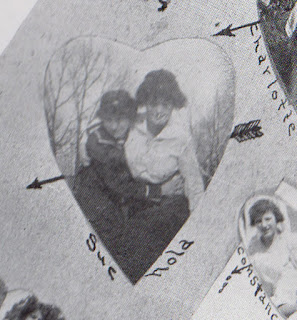
In the 1914 Crescent College yearbook, a page is devoted to "Crescent Crushes."  The early-twentieth-century equivalent of Best Friends Forever, Nola and Sue are a nearly inevitable pair - - and sure enough, there they are:

Nola Beam and Sue Hill
(second down from top, on left)
from the 1914 Crescent College Yearbook

 
Sue Hill and Nola Beam (close-up of above)

And now it's easy to understand why - - once they'd met - - these two might join forces and run away.

The story wasn't kept quiet: it was featured in newspapers across the nation. 
Daily Register-Gazette [Rockford, Illinois] 14 November 1913, Page 13.

TAKE RUNAWAY GIRLS
Insure Their Imprisonment By Taking Away Their Clothing.

(By Associated Press.)

Joplin, Mo., Nov. 14. - - A trip to Joplin, as a relief from the daily routine of college life was planned by Nola Beam of Shawnee, Okla., and Sue Hill of Ardmore, Okla., students at a girl’s seminary in Eureka Springs, Ark.

They slipped away and boarded a train for Joplin, but when they reached Monett, Mo., they were taken in charge by officials.

The girls were locked in a hotel room for the night and all their wearing apparel, save their night clothes, was taken from them by a maid, at the order of the police. When a representative of the Arkansas school arrived today the girls’ clothes were returned to them and they accompanied the faculty member back to Eureka Springs.
Understandably, the adventure was not featured in the 1914 Crescent College yearbook!

You might imagine that the pair might not have been welcomed back to Crescent, after this - - or that the girls, after Christmas holidays were over, might not return to Eureka Springs.

Crescent, in Winter
But January found them both back at Crescent College, and you'll find them on pages scattered throughout the yearbook.
Nola Beam, Class of 1916 (Sophomore Class)
(Nola is on the far left, at the bottom of "1")
1914 Crescent College yearbook
They both engaged in extracurricular activities...


Sue Hill in Crescent College Glee Club
from the 1914 yearbook
But Nola appears far more often than her companion.  Nola's in the Oklahoma Club, the Music Club, and affectionate fun is made at her expense in the Jokes pages.  She's one of the small number of girls studying in the Commercial Department.  

Nola Hill, student in the Commercial Department
Crescent College yearbook, 1914
The reason for Sue Hill's much less frequent appearance? 

She'd disappeared again.


Although she'd returned in January, Sue Hill wasn't at Crescent for Graduation Exercises on May 27. 

By that time, she'd been married over a month.


And who did she wed?

Remember the second murderer we mentioned, at the beginning of this article?


You've met the first murderer already, although you may not know it yet.  And so, this time we warn you:  our story is about to follow a much darker, and much more disturbing path. 

But if you care to follow the saga, we'll rejoin Sue Hill when we continue with "Now You See Her... or, Murder, Money, and Madness," Part Two.
       
   
To Be Continued....